Vector algebra is one of the most fundamental topics in secondary mathematics and physics. Before diving into complex operations such as dot products, cross products, and 3D geometry, it is essential to understand how different vectors behave and how they are classified. From magnitude to spatial orientation, vectors come in various types, each serving a unique purpose in problem-solving.
Key Types of Vectors Explained
To master vector mathematics, you must first become familiar with the basic categories you will encounter in your studies:
- Zero (Null) Vector: A vector whose magnitude is zero and whose initial and terminal points coincide. It carries no specific direction.
- Unit Vector: A vector that has a magnitude of exactly one unit. Unit vectors are primarily used to specify a direction in two-dimensional or three-dimensional space.
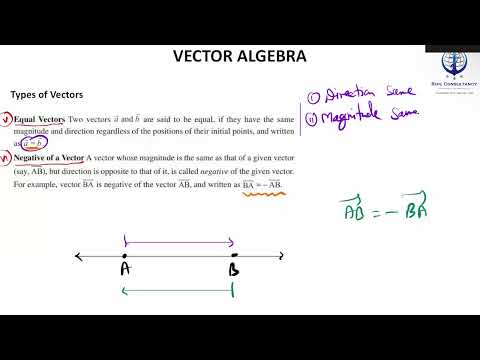
- Equal Vectors: Two vectors are considered equal if they possess the exact same magnitude and direction, regardless of where they start in space.
- Parallel (Collinear) Vectors: Vectors that lie along the same straight line or parallel lines, irrespective of their magnitudes.
Understanding Free Vectors in Mathematics
When working with vector algebra, you will frequently encounter the concept of free vectors. In mathematics and physics, free vectors are defined as vectors whose initial position is not restricted to a fixed point. As long as you maintain the vector's magnitude and direction, you can freely translate it anywhere in space parallel to its original line of action.
Recognizing free vectors simplifies geometric constructions and algebraic operations. It allows students to relocate vectors to form triangles or parallelograms when performing vector addition or subtraction without changing their fundamental values.
Why Mastering Vector Types Matters
Not all vectors behave the same way, and recognizing their distinct properties is critical before moving on to advanced mathematical applications. By establishing a solid foundation in identifying unit, zero, equal, parallel, and free vectors, you will build the confidence needed to solve complex Class 12 Maths problems efficiently.


