Showing posts with label Class 12 Maths. Show all posts

Understanding Types of Vectors: A Guide to Free Vectors and Beyond

Vectors play a fundamental role in higher-level mathematics and physics. Whether you are preparing for Class 12 Maths board exams or diving into competitive test preparation, mastering vector algebra starts with understanding how different vectors behave. Before performing complex calculations like scalar or vector products, you must first familiarize yourself with the primary types of vectors.

What Are Free Vectors?

In vector algebra, not all vectors are anchored to a fixed starting point. Most concepts in high school mathematics deal with free vectors. A free vector is defined purely by its magnitude and direction, independent of its initial position in a coordinate system.

Because location does not restrict free vectors, you can translate them parallel to themselves anywhere in space without altering their properties or value. This flexibility makes it much easier to perform operations like vector addition and subtraction visually and algebraically.

Essential Types of Vectors Explained

Beyond initial positioning, vectors are categorized by their specific magnitudes, directions, and relationships to one another. Here are the core types every student should recognize:

  • Zero (Null) Vector: A vector whose magnitude is zero and whose initial and terminal points coincide. It has no specified direction and is represented as $\vec{0}$.
  • Unit Vector: A vector that has a magnitude of exactly 1 unit. Unit vectors are used primarily to indicate direction and are denoted with a caret symbol, such as $\hat{a}$.
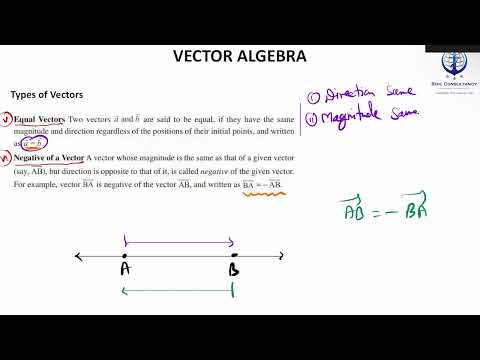
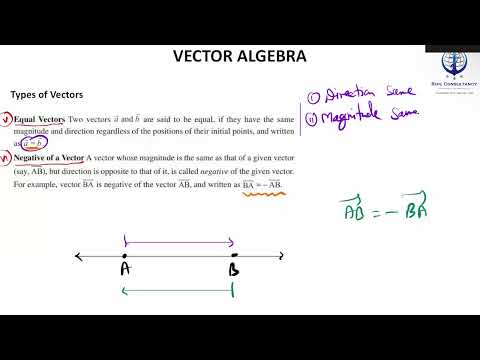
  • Equal Vectors: Two vectors are considered equal if they possess the exact same magnitude and point in the same direction, regardless of their initial positions.
  • Parallel Vectors: Vectors that share the same line of action or run parallel to one another. They can be classified as like vectors (same direction) or unlike vectors (opposite directions).

Why Vector Classification Matters

Differentiating between these categories prevents common algebraic mistakes in 3D geometry and physics problems. By mastering how free vectors interact with unit and zero vectors, you build a solid foundation for solving complex spatial equations with confidence. Keep practicing these core definitions, and vector algebra will quickly become one of your strongest mathematical topics.

Free vectors

A Complete Guide to Types of Vectors: Understanding Free Vectors, Unit Vectors, and More

Vector algebra is one of the most fundamental topics in secondary mathematics and physics. Before diving into complex operations such as dot products, cross products, and 3D geometry, it is essential to understand how different vectors behave and how they are classified. From magnitude to spatial orientation, vectors come in various types, each serving a unique purpose in problem-solving.

Key Types of Vectors Explained

To master vector mathematics, you must first become familiar with the basic categories you will encounter in your studies:

  • Zero (Null) Vector: A vector whose magnitude is zero and whose initial and terminal points coincide. It carries no specific direction.
  • Unit Vector: A vector that has a magnitude of exactly one unit. Unit vectors are primarily used to specify a direction in two-dimensional or three-dimensional space.
  • Equal Vectors: Two vectors are considered equal if they possess the exact same magnitude and direction, regardless of where they start in space.
  • Parallel (Collinear) Vectors: Vectors that lie along the same straight line or parallel lines, irrespective of their magnitudes.

Understanding Free Vectors in Mathematics

When working with vector algebra, you will frequently encounter the concept of free vectors. In mathematics and physics, free vectors are defined as vectors whose initial position is not restricted to a fixed point. As long as you maintain the vector's magnitude and direction, you can freely translate it anywhere in space parallel to its original line of action.

Recognizing free vectors simplifies geometric constructions and algebraic operations. It allows students to relocate vectors to form triangles or parallelograms when performing vector addition or subtraction without changing their fundamental values.

Why Mastering Vector Types Matters

Not all vectors behave the same way, and recognizing their distinct properties is critical before moving on to advanced mathematical applications. By establishing a solid foundation in identifying unit, zero, equal, parallel, and free vectors, you will build the confidence needed to solve complex Class 12 Maths problems efficiently.

Free vectors

Types of Vectors Explained: From Free Vectors to Unit and Equal Vectors

Vector algebra is a foundational concept in mathematics and physics, essential for understanding everything from physical forces and velocity to 3D computer graphics. However, not all vectors behave in the same way. To master vector operations, you must first understand the fundamental types of vectors and how their properties differ.

What Are Free Vectors?

In linear algebra and physics, free vectors play a crucial role. A free vector is defined entirely by its magnitude and direction, completely independent of its initial point or position in space. This means you can shift free vectors parallel to themselves anywhere in a coordinate system without altering their mathematical value. Because their starting point does not restrict them, they are widely used when analyzing forces, displacements, and standard vector addition.

Key Types of Vectors You Need to Know

Beyond free vectors, several specific vector types form the backbone of high school and college-level mathematics:

  • Zero (or Null) Vector: A vector whose magnitude is zero and whose direction is arbitrary or undefined. It is represented as $\vec{0}$ and serves as the additive identity in vector algebra.
  • Unit Vector: A vector that has a magnitude of exactly one unit. Unit vectors are primarily used to specify a direction in space without changing the magnitude of the quantity they multiply.
  • Equal Vectors: Two or more vectors are considered equal if they share both the exact same magnitude and direction, regardless of where their initial points are located.
  • Parallel and Collinear Vectors: Vectors that act along the same line or parallel lines. Parallel vectors can point in the same direction (like vectors) or opposite directions (unlike vectors).

Why Mastering Vector Types Matters

Before attempting complex calculations like scalar (dot) products, vector (cross) products, or 3D geometry problems, grasping these distinct vector types is essential. Recognizing whether you are working with unit vectors, zero vectors, or parallel vectors ensures precision and confidence when solving advanced math problems.

Free vectors

Master the Basics: Exploring Unit, Equal, and Free Vectors in Class 12 Maths

In the study of physics and advanced mathematics, vectors are more than just lines with arrows; they are the fundamental building blocks for understanding force, velocity, and spatial geometry. For Class 12 students, mastering vector algebra begins with a clear understanding of the different types of vectors. While they may look similar on paper, their mathematical properties vary significantly.

Understanding the Concept of Free Vectors

Before diving into specific types, it is crucial to understand the context in which we study them. In most standard mathematical problems, we deal with free vectors. These are vectors whose initial point is not restricted to a specific location in space. As long as the magnitude and direction remain unchanged, the vector can be moved parallel to itself. This flexibility of free vectors is what allows us to perform operations like addition and subtraction using the triangle or parallelogram laws easily.

The Essentials: Unit and Zero Vectors

Two of the most common types you will encounter are the Unit Vector and the Zero Vector.

  • Unit Vector: As the name suggests, a unit vector has a magnitude of exactly one. Its primary purpose is to indicate direction. In coordinate geometry, these are often represented by the symbols i, j, and k.
  • Zero Vector: Also known as a null vector, this has a magnitude of zero. Because it has no length, its direction is indeterminate. It acts as the identity element in vector addition.

Equal vs. Parallel Vectors

Distinguishing between equal and parallel vectors is a common area of confusion for students.

  1. Equal Vectors: Two vectors are considered equal only if they have the same magnitude and the same direction, regardless of their starting positions. Since we often work with free vectors in Class 12 Maths, two vectors are equal if they are parallel, point the same way, and are of the same length.
  2. Parallel (Collinear) Vectors: These vectors act along the same line or parallel lines. They can point in the same direction (like vectors) or opposite directions (unlike vectors). Their magnitudes do not have to be equal.

Why Classification Matters

Understanding these classifications is an essential prerequisite before moving on to complex vector operations, such as dot products and cross products. By recognizing whether you are working with a unit vector or a parallel vector, you can apply the correct algebraic rules and solve geometric problems with much higher accuracy.

Mastering these definitions is the first step toward excelling in your Class 12 board exams and competitive entrance tests. Keep practicing the visualization of these vectors to build a strong foundation in linear algebra!

Free vectors

Mastering Vector Algebra: A Guide to Free Vectors, Unit Vectors, and More

Vectors are fundamental mathematical tools used across physics, engineering, and advanced mathematics to represent quantities that possess both magnitude and direction. However, not all vectors behave in the exact same way. Before diving into complex vector operations, dot products, or cross products, it is essential to build a solid foundation by understanding the different types of vectors.

What Are Free Vectors?

In vector algebra, one of the most flexible concepts you will encounter is that of free vectors. A free vector is defined as a vector whose initial point is not restricted to a fixed position in space. As long as its magnitude and direction remain unchanged, it can be moved parallel to itself anywhere within a coordinate system.

Understanding how free vectors function makes solving geometric problems significantly easier. Because their starting points can be shifted freely, mathematicians and physicists can manipulate these vectors to form triangles, parallelograms, and polygon law diagrams without altering their core mathematical properties.

Common Types of Vectors Explained

Beyond free vectors, vector algebra classifies vectors into several distinct types based on their magnitude, direction, and initial positions:

  • Zero Vector (Null Vector): A vector whose magnitude is zero and whose initial and terminal points coincide. Since its length is zero, its direction cannot be specified and is considered arbitrary.
  • Unit Vector: A vector that has a magnitude of exactly one unit. Unit vectors are primarily used to indicate a specific direction in space without affecting the magnitude of other quantities.
  • Equal Vectors: Two vectors are defined as equal if they have the exact same magnitude and point in the same direction, regardless of their initial starting positions.
  • Parallel Vectors: Vectors that act along parallel lines or the same straight line. They share the same orientation, though their magnitudes and specific directions (same vs. opposite) may vary.

Why Understanding Vector Types Matters

Grasping these definitions is not just about memorization—it is a critical step for Class 12 Mathematics and introductory physics. Whether you are adding forces in mechanics or computing spatial positions in 3D geometry, recognizing whether you are working with unit vectors, zero vectors, or parallel vectors ensures accurate calculations and logical problem-solving.

Free vectors

Understanding Vector Algebra: A Guide to Free Vectors and Key Vector Types

Vectors are fundamental quantities in mathematics and physics that represent both magnitude and direction. However, not all vectors behave in the same way. To solve complex geometrical problems and master vector operations, you must first understand how vectors are classified. Among these classifications, free vectors are some of the most versatile concepts you will encounter in vector algebra.

What Are Free Vectors?

In vector geometry, free vectors are vectors whose position is not restricted to a fixed point in space. This means a free vector is defined purely by its magnitude and direction, rather than where it begins. As long as you maintain the original length and orientation, free vectors can be shifted anywhere parallel to themselves in a coordinate system without altering their mathematical value. This characteristic makes them essential for performing operations like vector addition, vector subtraction, and displacement calculations.

Essential Types of Vectors Explained

Beyond free vectors, several other fundamental vector types form the backbone of high school mathematics and physics:

  • Zero (Null) Vector: A vector whose magnitude is zero, meaning its initial and terminal points coincide. Its direction is arbitrary or undefined.
  • Unit Vector: A vector that has a magnitude of exactly one unit. Unit vectors are primarily used to indicate a specific direction in coordinate space and are often represented with a hat symbol (e.g., $\hat{a}$).
  • Equal Vectors: Two or more vectors are equal if they share the exact same magnitude and direction, regardless of their starting positions.
  • Parallel Vectors: Vectors that lie along parallel lines are known as parallel vectors. They can point in the same direction or opposite directions, regardless of whether their magnitudes are equal.

Why Mastering Vector Types Matters

Before diving into advanced vector operations such as dot products, cross products, and 3D coordinate geometry, recognizing the specific properties of each vector type is crucial. Knowing how to identify unit, zero, equal, and free vectors simplifies problem-solving and prevents common mistakes in algebraic calculations.

By building a solid conceptual understanding of these basic vector types today, you set yourself up for success in advanced mathematics, physics, and engineering!

Free vectors

A Complete Guide to Types of Vectors: Understanding Free Vectors and Beyond

Vectors play a fundamental role in higher mathematics, physics, and engineering. Before diving into complex vector operations like scalar products or cross products, it is essential to understand the different classifications of vectors and how they behave.

What Are Free Vectors?

In standard vector algebra, most operations deal with free vectors. A vector is considered a free vector when its origin or initial point is not restricted to a specific position in space. As long as its magnitude and direction remain unchanged, you can shift it anywhere parallel to its original path.

Understanding how free vectors operate allows students to manipulate geometric shapes and perform vector addition seamlessly across a coordinate plane without worrying about fixed reference points.

Key Types of Vectors Explained

To build a solid mathematical foundation, here are the primary types of vectors every Class 12 student should know:

  1. Zero Vector (Null Vector): A vector whose magnitude is zero and whose initial and terminal points coincide. It has no specific direction.
  2. Unit Vector: A vector that has a magnitude of exactly 1 unit. Unit vectors are primarily used to indicate direction in a three-dimensional plane (represented as $\hat{i}, \hat{j}, \hat{k}$).
  3. Equal Vectors: Two or more vectors are equal if they possess the exact same magnitude and point in the same direction, regardless of where their initial points are located.
  4. Parallel and Collinear Vectors: Vectors that act along the same line or along parallel lines, regardless of their magnitudes or specific starting positions.
  5. Co-initial Vectors: Vectors that share the same initial starting point.

Why Mastering Vector Types Matters

Differentiating between zero, unit, equal, and parallel vectors prevents common errors during vector calculations. Whether you are solving three-dimensional geometry problems or working with free vectors in calculus and physics, mastering these fundamental classifications will make complex operations much easier to visualize and solve.

Free vectors

Understanding Vector Mathematics: A Complete Guide to Types of Vectors and Free Vectors

Vectors play a fundamental role in both mathematics and physics, serving as the backbone for topics ranging from three-dimensional geometry to classical mechanics. However, not all vectors behave in the exact same way. To master advanced vector operations and solve complex algebraic equations, you must first understand the fundamental classification of vectors.

What Are Free Vectors in Mathematics?

In vector algebra, vectors are categorized based on their initial points, magnitudes, and geometric properties. One of the most important concepts to grasp early on is free vectors.

Unlike bound vectors—which are restricted to a fixed point or specific line of action—free vectors can be moved parallel to themselves anywhere in space without altering their magnitude or direction. In standard Class 12 Mathematics, almost all vectors we analyze are treated as free vectors. This spatial flexibility is crucial because it allows you to shift vectors across a coordinate plane to easily calculate vector addition, subtraction, and dot or cross products.

Essential Types of Vectors You Need to Know

To build a strong mathematical foundation, here are the core types of vectors you will encounter:

  • Zero Vector (Null Vector): A vector whose magnitude is exactly zero and whose initial and terminal points coincide. Because its magnitude is zero, its direction is arbitrary.
  • Unit Vector: A vector that has a magnitude of exactly 1 unit. Unit vectors are typically used to indicate direction along specific axes (such as $\hat{i}, \hat{j}, \hat{k}$).
  • Equal Vectors: Two vectors are defined as equal if they have the exact same magnitude and point in the same direction, regardless of their starting position.
  • Parallel and Collinear Vectors: Vectors that act along the same line or along parallel lines are collinear. Parallel vectors share either the same or opposite directions, regardless of their magnitudes.

Why Mastering Vector Types Matters

Before diving into advanced vector calculus or 3D geometry problems, you must be comfortable identifying these fundamental types. Knowing when to apply a unit vector, recognizing equal vectors, or freely shifting free vectors across a coordinate space will dramatically improve your speed and problem-solving accuracy.

Take the time to master these foundational definitions, and you will be well-prepared to tackle any vector algebra concept with confidence!

Free vectors

Master Vector Algebra: Types of Vectors and the Role of Free Vectors

In Class 12 Mathematics, vector algebra serves as a critical foundation for physics, engineering, and advanced calculus. While vectors are generally defined as quantities having both magnitude and direction, not all vectors behave in the exact same manner. Understanding their distinct classifications is essential before diving into vector addition, dot products, and cross products.

What Are Free Vectors?

Before exploring specific vector types, it is crucial to understand how vectors are represented in space. In mathematics and physics, free vectors are vectors whose initial positions are not fixed to a specific point. They are defined purely by their magnitude and direction. This means you can shift a vector parallel to itself anywhere in a coordinate plane without changing its fundamental properties. Most standard algebraic calculations rely heavily on free vectors because their starting location does not alter their mathematical value.

Key Types of Vectors You Must Know

To build a strong command over vector algebra, you should familiarize yourself with these essential classifications:

  • Zero (Null) Vector: A vector whose magnitude is zero, meaning its initial and terminal points coincide. Because its magnitude is zero, its direction is arbitrary or undefined.
  • Unit Vector: A vector with a magnitude of exactly one unit. Unit vectors are used primarily to indicate direction in space and are typically denoted with a hat symbol (e.g., $\hat{a}$).
  • Equal Vectors: Two or more vectors are equal if they possess the exact same magnitude and point in the exact same direction, regardless of where they start in space. In essence, equal vectors demonstrate how free vectors function in geometric space.
  • Parallel Vectors: Vectors that act along parallel lines. They can point in the same direction (co-directional) or opposite directions, regardless of whether their magnitudes are equal.

Conclusion

Mastering these basic classifications allows students to tackle complex 3D geometry problems and physics applications with confidence. By recognizing how different vector types interact, you establish a solid foundation for advanced mathematical operations and problem-solving.

Free vectors

Types of Vectors Explained: Understanding Free Vectors, Unit Vectors, and Beyond

In mathematics and physics, vectors are fundamental tools used to represent quantities that possess both magnitude and direction. However, not all vectors behave in the exact same way. Before diving into complex vector operations like dot products and cross products, it is essential to understand the primary types of vectors and how they function.

What Are Free Vectors?

When studying vector algebra, one of the most flexible concepts you will encounter is the idea of free vectors. A free vector is defined as a vector whose position in space is not fixed to a specific point. As long as its magnitude and direction remain completely unchanged, it can be shifted parallel to itself anywhere within a coordinate system. Most standard geometrical problems rely on free vectors because their origin point does not alter their mathematical properties, making addition and subtraction much easier to visualize.

Essential Types of Vectors Every Student Should Know

Beyond free vectors, there are several other critical vector classifications that every Class 12 Maths student should master:

  • Unit Vectors: A unit vector is a vector that has a magnitude of exactly one. Its main function is to specify a direction in space without altering the scale of other values.
  • Zero or Null Vectors: A zero vector is a vector with a magnitude of zero and an arbitrary or undefined direction. It acts as the identity element in vector addition.
  • Equal Vectors: Two vectors are called equal if and only if they share both the exact same magnitude and the exact same direction, regardless of where they start in space.
  • Parallel Vectors: Vectors that lie along parallel lines or the same line of action are parallel vectors. They can point in either the same direction or opposite directions.

Why Mastering Vector Types Matters

Gaining a strong grasp of these core definitions—especially knowing how free vectors interact during mathematical transformations—is a necessary step before attempting advanced topics. By building a clear understanding of how these vectors behave, you will set a strong foundation for tackling vector calculus, physics mechanics, and 3D geometry with confidence.

Free vectors

Understanding Types of Vectors: From Unit Vectors to Free Vectors

Vector algebra is one of the most foundational topics in senior secondary mathematics and physics. Before diving into complex vector operations like dot products or cross products, it is essential to understand that not all vectors behave in the same way. Every vector type serves a unique mathematical purpose in describing directional quantities.

In this guide, we will break down the essential types of vectors every student needs to master.

What Are Free Vectors?

In geometry and algebra, vectors are often categorized based on whether their position in space is fixed or movable. Most mathematical operations rely heavily on free vectors.

Unlike localized vectors that are tied to a specific point, free vectors are defined solely by their magnitude and direction. This means you can shift a vector parallel to itself anywhere in a coordinate system without altering its mathematical value or identity. Understanding free vectors is crucial because it allows mathematicians to simplify complex geometric problems by freely translating vectors to convenient starting locations, such as the origin.

Essential Types of Vectors Explained

Apart from free vectors, several other fundamental classifications form the bedrock of vector geometry:

  • Zero Vector (Null Vector): A vector whose magnitude is zero and whose initial and terminal points coincide. It represents a point rather than a line segment and lacks a specific direction.
  • Unit Vector: A vector that has a magnitude of exactly one unit. Unit vectors are primarily used to denote direction without scaling the magnitude of other elements.
  • Equal Vectors: Two vectors are considered equal if they possess the exact same magnitude and point in the same direction, regardless of where their initial points are located.
  • Parallel and Co-linear Vectors: Vectors that act along the same line or parallel lines. If they share the same direction, they are called "like vectors," whereas if they point in opposite directions, they are "unlike vectors."

Why Mastering Vector Types Matters

A solid grasp of vector classification lays the foundation for advanced topics like 3D geometry, calculus, and classical mechanics. When you clearly understand how different vectors function—and how free vectors can be translated across space—solving complex vector equations becomes far more intuitive.

Master these core definitions today to build a strong math foundation for your exams and future technical studies!

Free vectors