Vectors play a fundamental role in higher-level mathematics and physics. Whether you are preparing for Class 12 Maths board exams or diving into competitive test preparation, mastering vector algebra starts with understanding how different vectors behave. Before performing complex calculations like scalar or vector products, you must first familiarize yourself with the primary types of vectors.
What Are Free Vectors?
In vector algebra, not all vectors are anchored to a fixed starting point. Most concepts in high school mathematics deal with free vectors. A free vector is defined purely by its magnitude and direction, independent of its initial position in a coordinate system.
Because location does not restrict free vectors, you can translate them parallel to themselves anywhere in space without altering their properties or value. This flexibility makes it much easier to perform operations like vector addition and subtraction visually and algebraically.
Essential Types of Vectors Explained
Beyond initial positioning, vectors are categorized by their specific magnitudes, directions, and relationships to one another. Here are the core types every student should recognize:
- Zero (Null) Vector: A vector whose magnitude is zero and whose initial and terminal points coincide. It has no specified direction and is represented as $\vec{0}$.
- Unit Vector: A vector that has a magnitude of exactly 1 unit. Unit vectors are used primarily to indicate direction and are denoted with a caret symbol, such as $\hat{a}$.
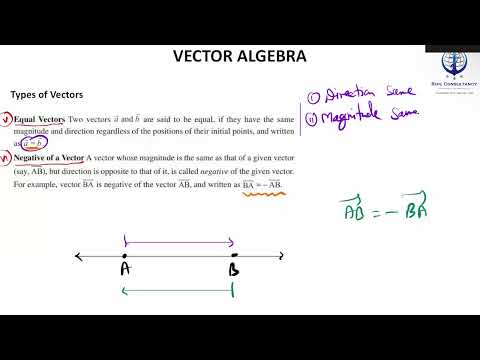
- Equal Vectors: Two vectors are considered equal if they possess the exact same magnitude and point in the same direction, regardless of their initial positions.
- Parallel Vectors: Vectors that share the same line of action or run parallel to one another. They can be classified as like vectors (same direction) or unlike vectors (opposite directions).
Why Vector Classification Matters
Differentiating between these categories prevents common algebraic mistakes in 3D geometry and physics problems. By mastering how free vectors interact with unit and zero vectors, you build a solid foundation for solving complex spatial equations with confidence. Keep practicing these core definitions, and vector algebra will quickly become one of your strongest mathematical topics.


