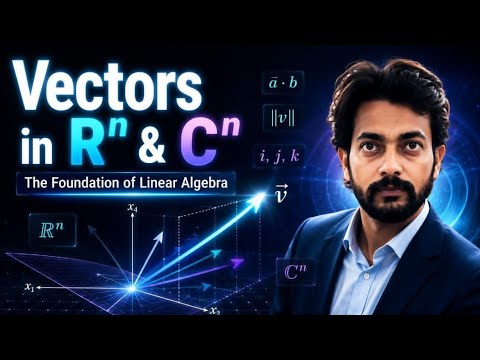
Linear algebra serves as the foundation for advanced mathematics, making it an essential subject for students preparing for the UPSC Maths Optional exam, as well as those pursuing BSc and MSc degrees. Among its core concepts, understanding different types of vectors and geometric structures like hyperplanes is vital for solving complex algebraic problems. In this article, we will break down the essential principles of located vectors, hyperplanes, and their mathematical significance.
What Are Free Vectors vs. Located Vectors?
In linear algebra and physics, vectors are defined by magnitude and direction. However, mathematicians classify vectors based on whether their position in space is fixed or flexible.
Free vectors are defined purely by their magnitude and direction, independent of any fixed starting point. You can translate free vectors anywhere within a vector space as long as their length and orientation remain unchanged. They represent general displacement rather than a fixed position.
In contrast, a located vector (often called a bound vector) is anchored to a specific initial point and terminal point in space. While free vectors allow for geometric mobility across a coordinate system, located vectors are crucial when pinning down precise geometric coordinates, points, and localized forces.
Understanding Hyperplanes in Vector Spaces
A hyperplane is a key concept in higher-dimensional geometry and linear algebra. Mathematically, in an $n$-dimensional vector space ($\mathbb{R}^n$), a hyperplane is a flat affine subspace of dimension $n - 1$.
To visualize this across dimensions: - In a 2D space ($\mathbb{R}^2$), a hyperplane is a 1-dimensional line. - In a 3D space ($\mathbb{R}^3$), a hyperplane is a 2-dimensional plane. - In higher dimensions ($\mathbb{R}^n$), a hyperplane acts as a boundary that divides the space into two distinct half-spaces.
Algebraically, a hyperplane is represented by a linear equation in the form: $$a_1x_1 + a_2x_2 + \dots + a_nx_n = c$$
Where the coefficients form a normal vector that defines the orientation of the hyperplane relative to vectors residing in that space.
Why These Concepts Matter for Higher Mathematics
Mastering the relationship between vectors and hyperplanes is essential for competitive examinations and advanced university coursework. These concepts form the cornerstone of topics such as linear programming, convex optimization, machine learning algorithms, and functional analysis.
By understanding how position-independent elements like vectors interact with localized geometric structures, students can build a robust conceptual framework to excel in UPSC Mathematics Optional, BSc, and MSc examinations.


