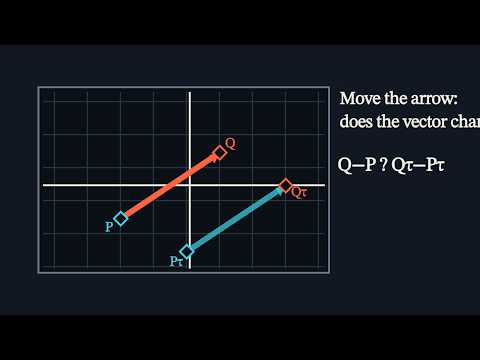
When you first start learning about vectors, it is easy to get caught up in the visuals. You see an arrow drawn on a graph, and your brain naturally wants to treat it like a physical object glued to a specific coordinate. But one of the most fundamental questions a student can ask is: "If I slide this arrow to a different part of the page, have I created a new vector?"
The short answer is no. To understand why, we have to look at what a vector actually represents.
What is a Vector, Really?
In mathematics and physics, understanding free vectors is the first step toward mastering spatial reasoning. A vector is not a fixed point in space; rather, it is a description of a "move" or a displacement. It is defined by two specific properties: magnitude (how far you are moving) and direction (which way you are going).
If you draw an arrow that represents moving three units right and two units up, that arrow represents a specific vector. If you pick that arrow up and move it five inches to the left without rotating it or stretching it, it still represents a move of "three units right and two units up."
The Concept of Displacement
Because these mathematical entities are considered free vectors, their location in space does not define their value. Think of it like a set of instructions. If I tell you to "take five steps north," those instructions remain the same whether you are standing in your kitchen or at the park. The starting position changes, but the "move" itself is identical.
In a diagram, as long as the length of the arrow (magnitude) and the angle of the arrow (direction) remain constant, the vector is unchanged. This is a powerful concept because it allows mathematicians to simplify complex systems by sliding vectors together to perform addition or subtraction, regardless of where they originated.
Why the "Move" Perspective Matters
Visualizing free vectors as movements rather than static lines helps unlock higher-level concepts in linear algebra and engineering. When we stop seeing an arrow as a "thing" at a "place" and start seeing it as a "change," the math becomes much more intuitive.
Next time you see a vector on a plane, remember: it isn't anchored to the ground. It is a mathematical instruction that stays the same no matter where it is drawn. By mastering this "Day 1" concept, you build a solid foundation for everything from classical mechanics to computer graphics.


