In mathematics and physics, vectors are fundamental tools used to represent quantities that possess both magnitude and direction. However, not all vectors behave in the exact same way. Before diving into complex vector operations like dot products and cross products, it is essential to understand the primary types of vectors and how they function.
What Are Free Vectors?
When studying vector algebra, one of the most flexible concepts you will encounter is the idea of free vectors. A free vector is defined as a vector whose position in space is not fixed to a specific point. As long as its magnitude and direction remain completely unchanged, it can be shifted parallel to itself anywhere within a coordinate system. Most standard geometrical problems rely on free vectors because their origin point does not alter their mathematical properties, making addition and subtraction much easier to visualize.
Essential Types of Vectors Every Student Should Know
Beyond free vectors, there are several other critical vector classifications that every Class 12 Maths student should master:
- Unit Vectors: A unit vector is a vector that has a magnitude of exactly one. Its main function is to specify a direction in space without altering the scale of other values.
- Zero or Null Vectors: A zero vector is a vector with a magnitude of zero and an arbitrary or undefined direction. It acts as the identity element in vector addition.
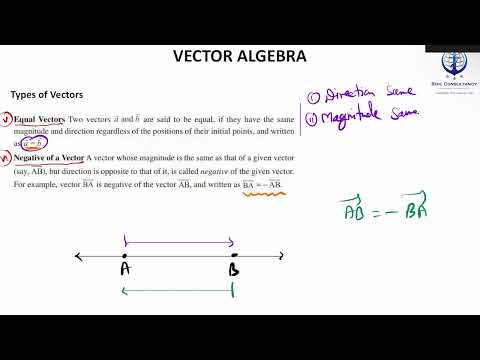
- Equal Vectors: Two vectors are called equal if and only if they share both the exact same magnitude and the exact same direction, regardless of where they start in space.
- Parallel Vectors: Vectors that lie along parallel lines or the same line of action are parallel vectors. They can point in either the same direction or opposite directions.
Why Mastering Vector Types Matters
Gaining a strong grasp of these core definitions—especially knowing how free vectors interact during mathematical transformations—is a necessary step before attempting advanced topics. By building a clear understanding of how these vectors behave, you will set a strong foundation for tackling vector calculus, physics mechanics, and 3D geometry with confidence.


