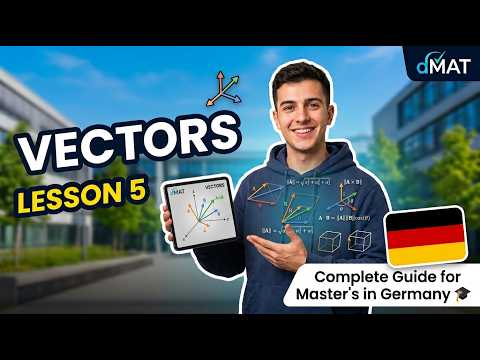
Welcome back to the dMAT Preparation Hub! As we move forward in our journey toward the dMAT 2026 entrance exam, we have officially reached a pivotal milestone. In Lesson 5, we transition into the highly anticipated Subject Module, starting with one of the most fundamental topics in physics and mathematics: Vectors.
Understanding the Foundation of Vectors
A vector is a quantity that possesses both magnitude and direction. In the context of competitive exams like the dMAT, understanding the behavior of these quantities is crucial. One of the first concepts students encounter is the distinction between bound vectors and free vectors. In linear algebra, free vectors are those that are characterized solely by their magnitude and direction, meaning they can be shifted anywhere in space without changing their mathematical value. Mastering the properties of these vectors allows you to simplify complex geometric problems into manageable algebraic equations.
Key Formulas and Calculations
To excel in the dMAT Subject Module, you must be comfortable with the core formulas. Lesson 5 breaks down the essential operations you will need to perform under exam pressure, including:
- Vector Addition and Subtraction: Using the parallelogram and triangle laws.
- Scalar Multiplication: Changing the magnitude of a vector without altering its orientation.
- The Dot Product: Calculating the angle between two vectors and determining orthogonality.
- Magnitude Calculation: Finding the "length" of a vector using the Pythagorean theorem in three-dimensional space.
By internalizing these formulas, you transform abstract concepts into tools that can be used to solve even the most challenging dMAT practice questions.
Why This Lesson Matters for dMAT 2026
The dMAT is designed to test your analytical thinking and your ability to apply mathematical theory to practical scenarios. Vectors form the language of the physical world; they are the building blocks for mechanics, electromagnetism, and advanced geometry.
As you go through your study sessions, remember that consistency is key. We recommend taking the time to draw out each problem visually. Whether you are calculating the displacement of an object or analyzing the force acting upon a point, visualizing these free vectors in a coordinate system will help prevent common calculation errors.
Conclusion and Next Steps
Lesson 5 is just the beginning of our deep dive into the dMAT Subject Module. By the end of this guide, you should feel confident in your ability to identify, manipulate, and calculate vector-based problems. Be sure to download our practice worksheets and follow along with the video to ensure you are fully prepared for the dMAT 2026. Stay focused, keep practicing, and let’s master these mathematical foundations together!


