Vector algebra is one of the most foundational topics in senior secondary mathematics and physics. Before diving into complex vector operations like dot products or cross products, it is essential to understand that not all vectors behave in the same way. Every vector type serves a unique mathematical purpose in describing directional quantities.
In this guide, we will break down the essential types of vectors every student needs to master.
What Are Free Vectors?
In geometry and algebra, vectors are often categorized based on whether their position in space is fixed or movable. Most mathematical operations rely heavily on free vectors.
Unlike localized vectors that are tied to a specific point, free vectors are defined solely by their magnitude and direction. This means you can shift a vector parallel to itself anywhere in a coordinate system without altering its mathematical value or identity. Understanding free vectors is crucial because it allows mathematicians to simplify complex geometric problems by freely translating vectors to convenient starting locations, such as the origin.
Essential Types of Vectors Explained
Apart from free vectors, several other fundamental classifications form the bedrock of vector geometry:
- Zero Vector (Null Vector): A vector whose magnitude is zero and whose initial and terminal points coincide. It represents a point rather than a line segment and lacks a specific direction.
- Unit Vector: A vector that has a magnitude of exactly one unit. Unit vectors are primarily used to denote direction without scaling the magnitude of other elements.
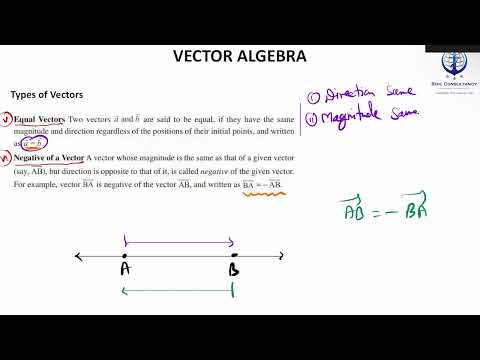
- Equal Vectors: Two vectors are considered equal if they possess the exact same magnitude and point in the same direction, regardless of where their initial points are located.
- Parallel and Co-linear Vectors: Vectors that act along the same line or parallel lines. If they share the same direction, they are called "like vectors," whereas if they point in opposite directions, they are "unlike vectors."
Why Mastering Vector Types Matters
A solid grasp of vector classification lays the foundation for advanced topics like 3D geometry, calculus, and classical mechanics. When you clearly understand how different vectors function—and how free vectors can be translated across space—solving complex vector equations becomes far more intuitive.
Master these core definitions today to build a strong math foundation for your exams and future technical studies!


