Vectors play a fundamental role in both mathematics and physics, serving as the backbone for topics ranging from three-dimensional geometry to classical mechanics. However, not all vectors behave in the exact same way. To master advanced vector operations and solve complex algebraic equations, you must first understand the fundamental classification of vectors.
What Are Free Vectors in Mathematics?
In vector algebra, vectors are categorized based on their initial points, magnitudes, and geometric properties. One of the most important concepts to grasp early on is free vectors.
Unlike bound vectors—which are restricted to a fixed point or specific line of action—free vectors can be moved parallel to themselves anywhere in space without altering their magnitude or direction. In standard Class 12 Mathematics, almost all vectors we analyze are treated as free vectors. This spatial flexibility is crucial because it allows you to shift vectors across a coordinate plane to easily calculate vector addition, subtraction, and dot or cross products.
Essential Types of Vectors You Need to Know
To build a strong mathematical foundation, here are the core types of vectors you will encounter:
- Zero Vector (Null Vector): A vector whose magnitude is exactly zero and whose initial and terminal points coincide. Because its magnitude is zero, its direction is arbitrary.
- Unit Vector: A vector that has a magnitude of exactly 1 unit. Unit vectors are typically used to indicate direction along specific axes (such as $\hat{i}, \hat{j}, \hat{k}$).
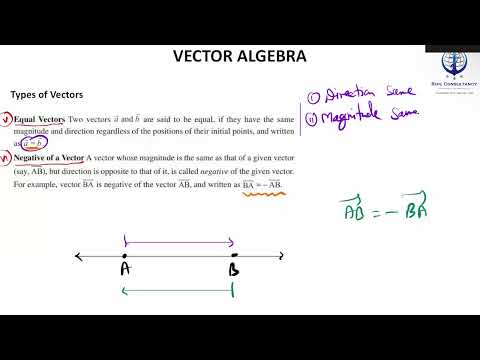
- Equal Vectors: Two vectors are defined as equal if they have the exact same magnitude and point in the same direction, regardless of their starting position.
- Parallel and Collinear Vectors: Vectors that act along the same line or along parallel lines are collinear. Parallel vectors share either the same or opposite directions, regardless of their magnitudes.
Why Mastering Vector Types Matters
Before diving into advanced vector calculus or 3D geometry problems, you must be comfortable identifying these fundamental types. Knowing when to apply a unit vector, recognizing equal vectors, or freely shifting free vectors across a coordinate space will dramatically improve your speed and problem-solving accuracy.
Take the time to master these foundational definitions, and you will be well-prepared to tackle any vector algebra concept with confidence!


