In Class 12 Mathematics, vector algebra serves as a critical foundation for physics, engineering, and advanced calculus. While vectors are generally defined as quantities having both magnitude and direction, not all vectors behave in the exact same manner. Understanding their distinct classifications is essential before diving into vector addition, dot products, and cross products.
What Are Free Vectors?
Before exploring specific vector types, it is crucial to understand how vectors are represented in space. In mathematics and physics, free vectors are vectors whose initial positions are not fixed to a specific point. They are defined purely by their magnitude and direction. This means you can shift a vector parallel to itself anywhere in a coordinate plane without changing its fundamental properties. Most standard algebraic calculations rely heavily on free vectors because their starting location does not alter their mathematical value.
Key Types of Vectors You Must Know
To build a strong command over vector algebra, you should familiarize yourself with these essential classifications:
- Zero (Null) Vector: A vector whose magnitude is zero, meaning its initial and terminal points coincide. Because its magnitude is zero, its direction is arbitrary or undefined.
- Unit Vector: A vector with a magnitude of exactly one unit. Unit vectors are used primarily to indicate direction in space and are typically denoted with a hat symbol (e.g., $\hat{a}$).
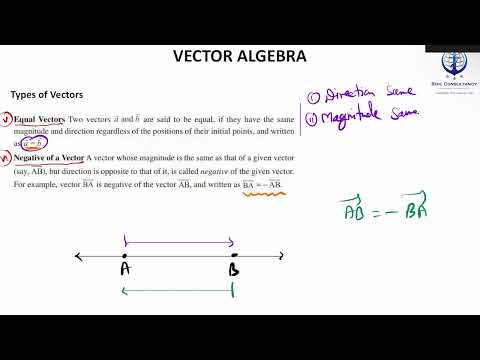
- Equal Vectors: Two or more vectors are equal if they possess the exact same magnitude and point in the exact same direction, regardless of where they start in space. In essence, equal vectors demonstrate how free vectors function in geometric space.
- Parallel Vectors: Vectors that act along parallel lines. They can point in the same direction (co-directional) or opposite directions, regardless of whether their magnitudes are equal.
Conclusion
Mastering these basic classifications allows students to tackle complex 3D geometry problems and physics applications with confidence. By recognizing how different vector types interact, you establish a solid foundation for advanced mathematical operations and problem-solving.


