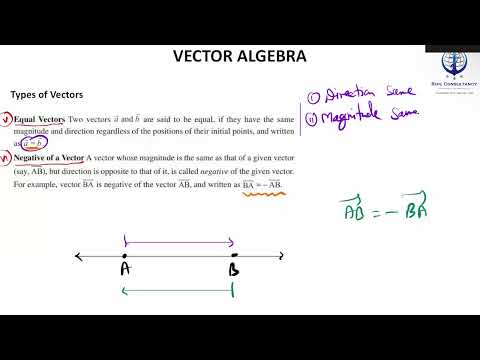
Vectors are fundamental mathematical tools used across physics, engineering, and advanced mathematics to represent quantities that possess both magnitude and direction. However, not all vectors behave in the exact same way. Before diving into complex vector operations, dot products, or cross products, it is essential to build a solid foundation by understanding the different types of vectors.
What Are Free Vectors?
In vector algebra, one of the most flexible concepts you will encounter is that of free vectors. A free vector is defined as a vector whose initial point is not restricted to a fixed position in space. As long as its magnitude and direction remain unchanged, it can be moved parallel to itself anywhere within a coordinate system.
Understanding how free vectors function makes solving geometric problems significantly easier. Because their starting points can be shifted freely, mathematicians and physicists can manipulate these vectors to form triangles, parallelograms, and polygon law diagrams without altering their core mathematical properties.
Common Types of Vectors Explained
Beyond free vectors, vector algebra classifies vectors into several distinct types based on their magnitude, direction, and initial positions:
- Zero Vector (Null Vector): A vector whose magnitude is zero and whose initial and terminal points coincide. Since its length is zero, its direction cannot be specified and is considered arbitrary.
- Unit Vector: A vector that has a magnitude of exactly one unit. Unit vectors are primarily used to indicate a specific direction in space without affecting the magnitude of other quantities.
- Equal Vectors: Two vectors are defined as equal if they have the exact same magnitude and point in the same direction, regardless of their initial starting positions.
- Parallel Vectors: Vectors that act along parallel lines or the same straight line. They share the same orientation, though their magnitudes and specific directions (same vs. opposite) may vary.
Why Understanding Vector Types Matters
Grasping these definitions is not just about memorization—it is a critical step for Class 12 Mathematics and introductory physics. Whether you are adding forces in mechanics or computing spatial positions in 3D geometry, recognizing whether you are working with unit vectors, zero vectors, or parallel vectors ensures accurate calculations and logical problem-solving.


