In the study of physics and advanced mathematics, vectors are more than just lines with arrows; they are the fundamental building blocks for understanding force, velocity, and spatial geometry. For Class 12 students, mastering vector algebra begins with a clear understanding of the different types of vectors. While they may look similar on paper, their mathematical properties vary significantly.
Understanding the Concept of Free Vectors
Before diving into specific types, it is crucial to understand the context in which we study them. In most standard mathematical problems, we deal with free vectors. These are vectors whose initial point is not restricted to a specific location in space. As long as the magnitude and direction remain unchanged, the vector can be moved parallel to itself. This flexibility of free vectors is what allows us to perform operations like addition and subtraction using the triangle or parallelogram laws easily.
The Essentials: Unit and Zero Vectors
Two of the most common types you will encounter are the Unit Vector and the Zero Vector.
- Unit Vector: As the name suggests, a unit vector has a magnitude of exactly one. Its primary purpose is to indicate direction. In coordinate geometry, these are often represented by the symbols i, j, and k.
- Zero Vector: Also known as a null vector, this has a magnitude of zero. Because it has no length, its direction is indeterminate. It acts as the identity element in vector addition.
Equal vs. Parallel Vectors
Distinguishing between equal and parallel vectors is a common area of confusion for students.
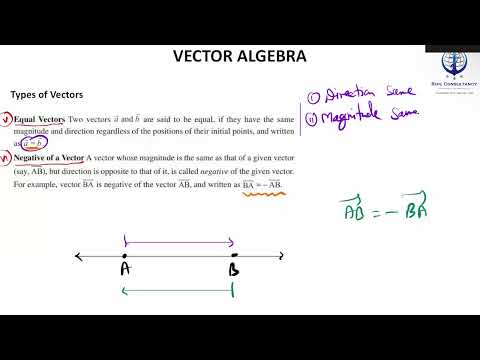
- Equal Vectors: Two vectors are considered equal only if they have the same magnitude and the same direction, regardless of their starting positions. Since we often work with free vectors in Class 12 Maths, two vectors are equal if they are parallel, point the same way, and are of the same length.
- Parallel (Collinear) Vectors: These vectors act along the same line or parallel lines. They can point in the same direction (like vectors) or opposite directions (unlike vectors). Their magnitudes do not have to be equal.
Why Classification Matters
Understanding these classifications is an essential prerequisite before moving on to complex vector operations, such as dot products and cross products. By recognizing whether you are working with a unit vector or a parallel vector, you can apply the correct algebraic rules and solve geometric problems with much higher accuracy.
Mastering these definitions is the first step toward excelling in your Class 12 board exams and competitive entrance tests. Keep practicing the visualization of these vectors to build a strong foundation in linear algebra!


