Vector algebra is a foundational concept in mathematics and physics, essential for understanding everything from physical forces and velocity to 3D computer graphics. However, not all vectors behave in the same way. To master vector operations, you must first understand the fundamental types of vectors and how their properties differ.
What Are Free Vectors?
In linear algebra and physics, free vectors play a crucial role. A free vector is defined entirely by its magnitude and direction, completely independent of its initial point or position in space. This means you can shift free vectors parallel to themselves anywhere in a coordinate system without altering their mathematical value. Because their starting point does not restrict them, they are widely used when analyzing forces, displacements, and standard vector addition.
Key Types of Vectors You Need to Know
Beyond free vectors, several specific vector types form the backbone of high school and college-level mathematics:
- Zero (or Null) Vector: A vector whose magnitude is zero and whose direction is arbitrary or undefined. It is represented as $\vec{0}$ and serves as the additive identity in vector algebra.
- Unit Vector: A vector that has a magnitude of exactly one unit. Unit vectors are primarily used to specify a direction in space without changing the magnitude of the quantity they multiply.
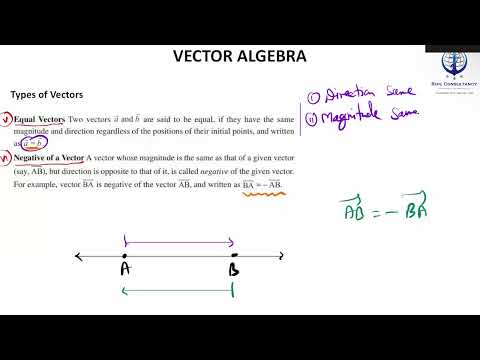
- Equal Vectors: Two or more vectors are considered equal if they share both the exact same magnitude and direction, regardless of where their initial points are located.
- Parallel and Collinear Vectors: Vectors that act along the same line or parallel lines. Parallel vectors can point in the same direction (like vectors) or opposite directions (unlike vectors).
Why Mastering Vector Types Matters
Before attempting complex calculations like scalar (dot) products, vector (cross) products, or 3D geometry problems, grasping these distinct vector types is essential. Recognizing whether you are working with unit vectors, zero vectors, or parallel vectors ensures precision and confidence when solving advanced math problems.


