Vectors play a fundamental role in higher mathematics, physics, and engineering. Before diving into complex vector operations like scalar products or cross products, it is essential to understand the different classifications of vectors and how they behave.
What Are Free Vectors?
In standard vector algebra, most operations deal with free vectors. A vector is considered a free vector when its origin or initial point is not restricted to a specific position in space. As long as its magnitude and direction remain unchanged, you can shift it anywhere parallel to its original path.
Understanding how free vectors operate allows students to manipulate geometric shapes and perform vector addition seamlessly across a coordinate plane without worrying about fixed reference points.
Key Types of Vectors Explained
To build a solid mathematical foundation, here are the primary types of vectors every Class 12 student should know:
- Zero Vector (Null Vector): A vector whose magnitude is zero and whose initial and terminal points coincide. It has no specific direction.
- Unit Vector: A vector that has a magnitude of exactly 1 unit. Unit vectors are primarily used to indicate direction in a three-dimensional plane (represented as $\hat{i}, \hat{j}, \hat{k}$).
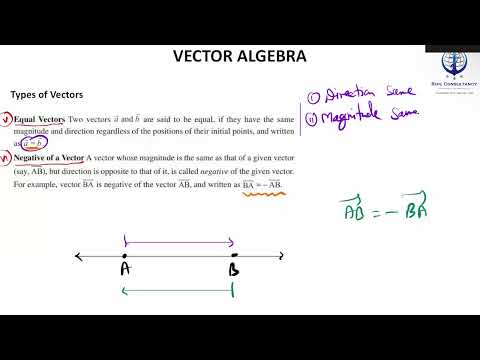
- Equal Vectors: Two or more vectors are equal if they possess the exact same magnitude and point in the same direction, regardless of where their initial points are located.
- Parallel and Collinear Vectors: Vectors that act along the same line or along parallel lines, regardless of their magnitudes or specific starting positions.
- Co-initial Vectors: Vectors that share the same initial starting point.
Why Mastering Vector Types Matters
Differentiating between zero, unit, equal, and parallel vectors prevents common errors during vector calculations. Whether you are solving three-dimensional geometry problems or working with free vectors in calculus and physics, mastering these fundamental classifications will make complex operations much easier to visualize and solve.


