Vectors are fundamental quantities in mathematics and physics that represent both magnitude and direction. However, not all vectors behave in the same way. To solve complex geometrical problems and master vector operations, you must first understand how vectors are classified. Among these classifications, free vectors are some of the most versatile concepts you will encounter in vector algebra.
What Are Free Vectors?
In vector geometry, free vectors are vectors whose position is not restricted to a fixed point in space. This means a free vector is defined purely by its magnitude and direction, rather than where it begins. As long as you maintain the original length and orientation, free vectors can be shifted anywhere parallel to themselves in a coordinate system without altering their mathematical value. This characteristic makes them essential for performing operations like vector addition, vector subtraction, and displacement calculations.
Essential Types of Vectors Explained
Beyond free vectors, several other fundamental vector types form the backbone of high school mathematics and physics:
- Zero (Null) Vector: A vector whose magnitude is zero, meaning its initial and terminal points coincide. Its direction is arbitrary or undefined.
- Unit Vector: A vector that has a magnitude of exactly one unit. Unit vectors are primarily used to indicate a specific direction in coordinate space and are often represented with a hat symbol (e.g., $\hat{a}$).
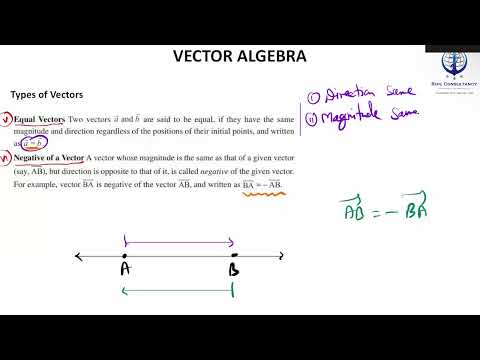
- Equal Vectors: Two or more vectors are equal if they share the exact same magnitude and direction, regardless of their starting positions.
- Parallel Vectors: Vectors that lie along parallel lines are known as parallel vectors. They can point in the same direction or opposite directions, regardless of whether their magnitudes are equal.
Why Mastering Vector Types Matters
Before diving into advanced vector operations such as dot products, cross products, and 3D coordinate geometry, recognizing the specific properties of each vector type is crucial. Knowing how to identify unit, zero, equal, and free vectors simplifies problem-solving and prevents common mistakes in algebraic calculations.
By building a solid conceptual understanding of these basic vector types today, you set yourself up for success in advanced mathematics, physics, and engineering!


